The term Bauhaus literally means «construction house» and was originally referring to the school of design which merged the former Grand Ducal School of Arts and Crafts and the Weimar Academy of Fine Art.
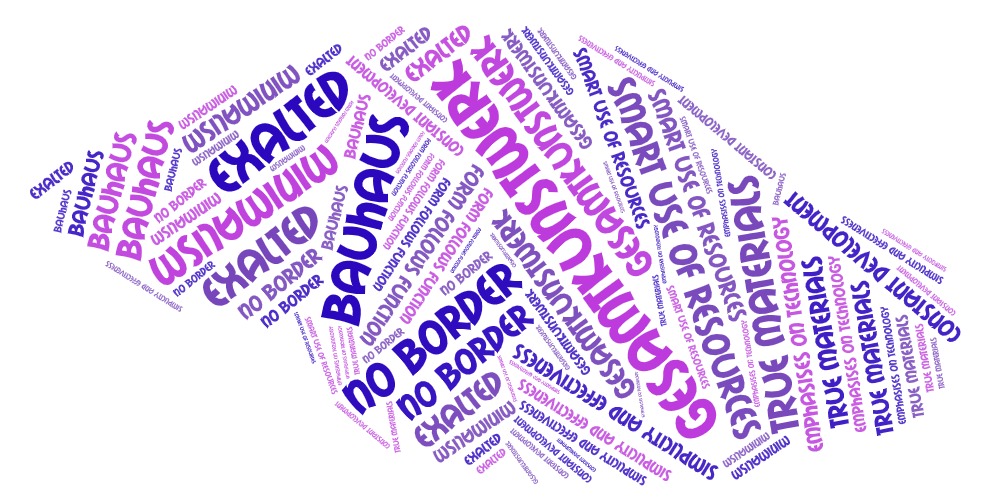
No border between artist and craftsman– In a pamphlet for an April 1919 exhibition, Gropius stated that his goal was «to create a new guild of craftsmen, without the class distinctions which raise an arrogant barrier between craftsman and artist».
The artist is an exalted craftsman– In rare moments of inspiration, moments beyond the control of his will, the grace of heaven may cause his work to blossom into art.
Form follows function– According to this idea, simple but elegant geometric shapes were designed based on the intended function or purpose of a building or an object.
Gesamtkunstwerk or the ‘complete work of art’– Gesamtkunstwerk means a synthesis of multiple art forms such as fine and decorative arts.
True materials– Materials should reflect the true nature of objects and buildings.
Minimalism– Bauhaus artists favoured linear and geometrical forms, avoiding floral or curvilinear shapes.
Emphasises on technology– Bauhaus workshops were used for developing prototypes of products for mass production.
Smart use of resources– Bauhaus ideology is characterised by the economic way of thinking.
Simplicity and Effectiveness– There is no need for additional ornamenting and making things more and more ‘beautiful’.
Constant development– Bauhaus is all about new techniques, new materials, new ways of construction, new attitude – all the time.
Link– https://art.art/blog/10-bauhaus-principles-that-still-apply-today/
News– https://www.nytimes.com/2019/02/04/t-magazine/bauhaus-school-architecture-history.html
Video– https://www.youtube.com/watch?v=wXVEFXQIS4c
 Josh's Blog